
Built in partnership with Sandia National Laboratories
Solar Thermal Energy Planner (STEP 1) provides decision support to assess the technical viability and economic opportunity for solar+storage systems to meet industrial process heat demands.
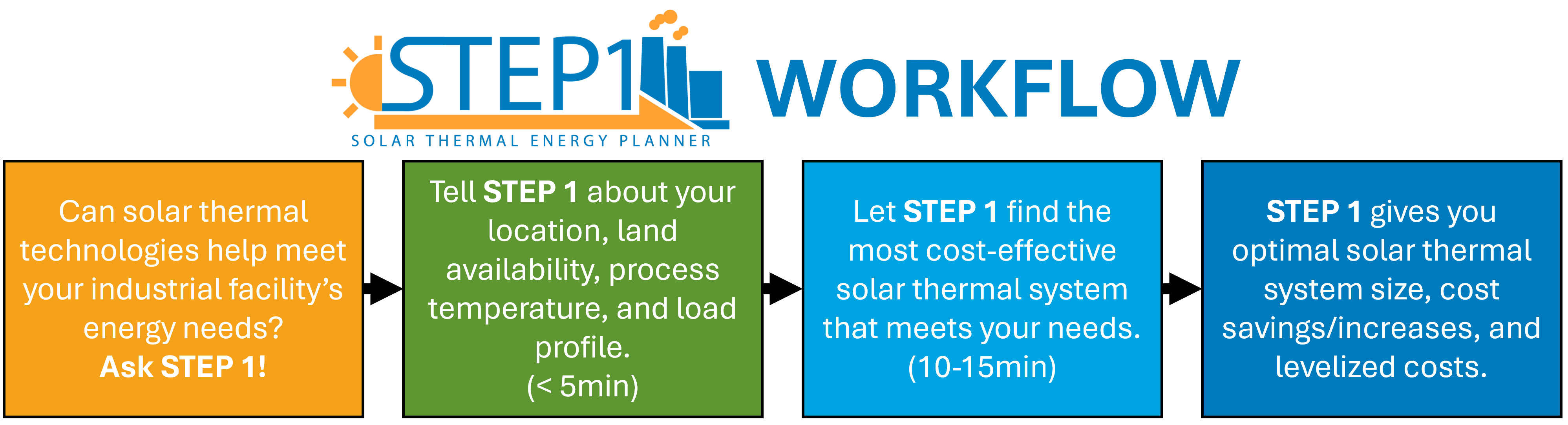
STEP 1 is co-developed by the National Renewable Energy Laboratory and Sandia National Laboratory combining expertise across the two labs in solar thermal and thermal energy storage technologies. The aim of STEP 1 is to provide techno-economic analysis for free to industrial customers seeking cost-effective alternatives for their industrial heat (and power) demand. The tool requires users to provide information about their location, land availability, process temperature, and load profile to complete the assessment with additional parameters available for users with more specific information. STEP 1 covers a wide range of solar thermal technologies (e.g., flat plate collectors, parabolic troughs, and molten salt towers) to accommodate the diversity of industrial process temperatures required. First, NREL’s System Advisory Model (SAM) is leveraged to generate a nominal thermal production profile given your facility specifications and land availability. Then, a tailored version of NREL’s REopt platform determines the optimal size and dispatch of the solar+storage system subject to local solar resource, renewable energy costs, land constraints, fuel and electricity prices, emission reduction goals, and financial constraints. STEP 1 post processes the optimization results to present useful decision metrics such as levelized cost of heat (to be compared to your existing fuel bill), net present value (to indicate energy input cost savings or cost increases), and total capital costs.
For questions, feedback, and/or other inquiries, please contact Jeffrey Gifford (Jeffrey.Gifford@nrel.gov) and Jeremy Sment (JSment@sandia.gov)
Share

Last Updated Aug. 20, 2025